
POMPEII · 1ST CENTURY AD
Julia Felix — A Woman of Pompeii
Here we are visiting the Roman Pompeii, the old market and trading town of the 1st century AD on the Bay of Naples. And here we are looking at one section of an old itinerarium, or road map, found in the middle ages. Scholars usually date this map to the 3rd or 4th century, but it has something extraordinary about it that defies that dating.
Pompeii, to the right of Herculaneum and Oplontis on the Roman road system, the Cursus Publicus, from the Tabula Peutingeriana.
If you look carefully at the dome structure near the water, in the center at the left just below the red letter N, beside two small red-roofed houses is the name Neapoli. This is Naples. Now if you trace the red line to the right you come to Herculaneum under the red letter I, and then a little further to the right the name Oplontis, which sits above a large villa-type structure and then, to the right of that, two more small red-roofed houses with the name Pompeii above.
The reason this is so remarkable is that these three sites on the map, Herculaneum, Oplontis and Pompeii were completely lost in the eruption of Mount Vesuvius in the 1st century, in 79. They were buried under twenty metres of ash and debris and forgotten until the 18th century. This itinerarium or old map is actually much older than the 3rd or 4th century. Perhaps it is based on maps that were commissioned by the 1st Emperor Augustus, through his general Agrippa, in the process of mapping the Cursus Publicus. The Cursus Publicus was used by the Emperor for official communications via courier and by Rome's armies during campaigns. It's the ancient Roman road system built to connect the entire empire during the peaceful and prosperous Pax Romana, roughly the 1st and 2nd centuries. It ran the length and breadth of the empire from England to Spain, through most of Western Europe, all around the Mediterranean Sea, across the north of Africa, Greece, Turkey and Egypt, to the Middle East and beyond.
The map is 22 feet long and a little over a foot high and rolls into a scroll much as it would have in the 1st century. The image above shows a man holding a scroll under his chin. The other, shows one lying on a shelf and slightly opened. A traveler would carry the map on trips and consult it for exact distances between stops and also to see what amenities are available along the way. Oplontis indicates, with its large walled structure that all needed resources are available there for the authorized visitor — accommodation, food, a bath and care for horses.

The town of Pompeii with the large property of Julia Felix (rust coloured) on the main street, the Decumanus Maximus, called the Via dell'Abondanza. Close by, are the Amphitheatre (in yellow) and the large Palaestra (green).
As her estate covered two entire insula, it had a larger footprint than most properties in Pompeii, approaching the size of the Temple of Venus (purple) in the forum, or the gladiator barracks (green) near the town's large and small theatres. Note: it was the Etruscans that introduced gladiators to the Romans. After the earthquake in 62 AD, Julia Felix let out parts of the villa including expensive apartments, her luxurious baths inspired by Venus and the leisure gardens.
Fresco of Terentius Neo and his wife, Pompeii. Fresco in the Villa of Julia Felix with money bag, piles of coins, a stylus and wax tablets used for keeping accounts, like the ones seen in the portrait.
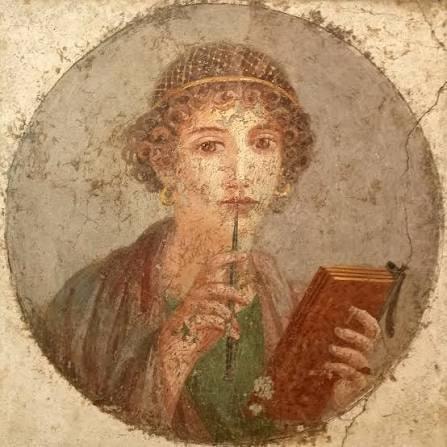
So let's visit the Villa of Julia Felix. Julia Felix is such an interesting person and she helps us in our understanding of the many characters who lived in this Campanian town in the 1st century. Julia Felix might have looked like the woman in the first fresco above discovered in Pompeii in the 18th century. Commonly mistaken for Sappho, it portrays a Pompeian woman with gold-threaded hair and large gold earrings, stylus to her mouth and holding wax tablets used for accounts, as in the fresco above found in the Villa of Julia Felix with piles of coins, a scroll and a stylus and wax tablets.
View of the Villa of Julia Felix taken from the pergola. Looking across the long water feature toward the Baths of Venus in the distance.
Roman naming tradition suggests Julia could be descended from the line of the Juli, and her name Felix means 'fortunate one'. She certainly was fortunate, being a single woman who owned significant property at a time when this was very rare indeed.
She also managed to influence legal authorities to allow the combining of two insula into one, which meant closing the part of the Pompeian street that ran between the two parcels of land. Each insula is the size of a city block.
She ran a successful rental and dining business that catered to the well-to-do, complete with private baths, extensive fruit trees and vegetable gardens, and an ornate water system.
She also had three tabernae or taverns that catered to the ordinary people of Pompeii, only a stone's throw away from the popular amphitheatre and the large Palaestra, an outdoor exercise field with covered porticos for strolling, near the Sarno Gate of the town.
Here we see her home, the domus at the top in red, as well as a very large dining area and rooms for servants. At the bottom, in green, is the very large bath complex and three tabernae in white.
The rest of the property was planted with gardens and fruit trees and water features, hence the name the Praedia of Julia Felix, or estate. Our research shows that the villa sustained damages in a famous earthquake in 62 BC and Julia Felix made extensive repairs, an idea reinforced by the contemporary 4th style wall paintings throughout the villa, the latest painting style at the time.
"To let, for the term of five years, from the thirteenth day of next August to the thirteenth day of the sixth August thereafter, the Venus bath, fitted for the best people, shops, and rooms over shops and second story apartments in the property owned by Julia Felix, daughter of Spurius."
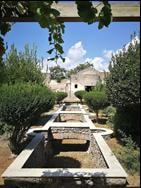
Kitchen frescos from the villa of Julia Felix on either side of the water feature in the garden that leads to the Venus baths.
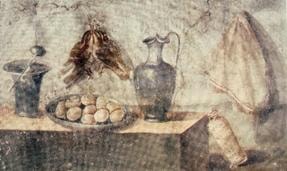
Still-life fresco from the Villa of Julia Felix, Pompeii. Photo © Don Fenton.
She would have had dealings with many people in the town. For the approval of enlarging her property and closing the street that ran between the two insula, she would have visited the Basilica in the forum.
Inside this sumptuous building from 130 BC judges sat for business and judicial affairs. Unlike the Etruscans, only an elite Roman woman could own and transfer property without a male guardian.
She may have attended a play or recital at the large theatre. This well preserved stone theatre seated 5,000 people, the upper classes in the ima or lower section, the middle class in the media or middle, with the plebians up top in the summa.
Julia could also have enjoyed staged musical concert performances in the roofed small theatre that seated 1,500 more educated Pompeiians. This theatre would have resembled Andrea Palladio's Teatro Olimpico in Vicenza, Italy. The Italian Renaissance architect spent his life studying ancient Roman architecture.

Don Fenton, Classic Time Travel
Download full article (PDF)