
ROMAN HOLIDAY
New dig reveals 'lost' blue pigment from 2,000 years ago
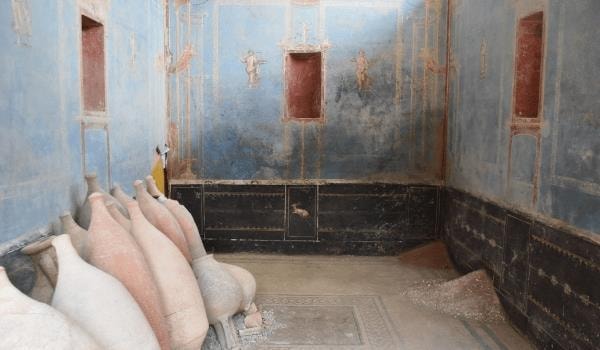
The 'blue room' at Pompeii. Credit: Pompeii Archeological Park.
Calcium copper silicate was forgotten until mid-2024 when an archeological dig in Pompeii revealed the 'blue room' in a newly excavated insula. Images of the room painted with this lost blue pigment were published in the journal of Pompeii's excavations.
Toronto, ON, July 8, 2026 – Local history writer Don Fenton asked High Park Paints in Roncesvalles Village to re-create the blue pigment from the Pompeii archeological discovery, as he paints a room at home to celebrate his modest collection of Roman art.
Fenton imagined the lost colour on the walls of his own 'blue room' after studying reports of the find at Pompeii's Archeological Park near Italy's Amalfi Coast, where the town thrived before the Mount Vesuvius volcano devastated and buried it in 79 AD. (Wikipedia: Eruption of 79 AD)
News coverage has been enthusiastic: NBC, ABC, CBS, CNN, BBC, PBS, CTV, MSN, Aol, Today, Smithsonian Magazine, Archeology Magazine, Euronews, TikTok, FB, Instagram, The Guardian, CityNews, Fox, Good Morning America, Science, Daily Express, The Times and Newsweek, to name a few.
1st century Roman historians Pliny and Vitruvius knew the blue pigment as an expensive Egyptian Blue, a calcium copper silicate produced in Egypt and visible in its art since the 3rd millennium BC. It was brought to Rome and produced there before disappearing with the empire's decline. Pliny and Vitruvius knew the blue pigment as an expensive Egyptian Blue.
Vitruvius wrote about it in his 10 books on architecture, book 7, chapter 11, verse 1: "... made from sand and ground with sulphur into a flour, water and copper added to make a paste, rolled into balls, dried, then fired in a furnace" for the fine blue colour.
The one other reference to the lost pigment was in the Middle Ages when the painter Raphael mixed and used it with his 1514 wall painting 'Triumph at Galatea' on a wall in the Villa Farnesina, at Rome. It then faded again from view. (Wikipedia: Triumph of Galatea)
Quick Facts
- Gabriel Zuchtriegel, Director of the Archaeological park at Pompeii, says the find gives us "ideas for conversations about the past and life" from which we can "explore the way our lives are entangled with the broad sweep of history".
- This new excavation of Insula 10, Regio IX is part of a plan to protect excavated and unexcavated areas, improve hydrogeology, and make Pompeii's 13,000 rooms in 1,070 residences more sustainable.
- It reveals two interconnected houses with sumptuous frescoed rooms, a bakery and a laundry overlooking Via di Nola running through the centre of Pompeii.
Quotes
"Pompeii's Archeological Park is preserving the richness of this incredible town's history. It is discoveries like this – hidden for centuries – that make the story so exciting."
— Don Fenton, Classic Time Travel
"We are happy to recreate the formula for the rare colour Pompeii Blue, and excited to offer the completely new 'Pompeii Blue colour palette' to our customers in the Roncesvalles neighbourhood."
— Peter Wenglowsky, Manager, High Park Paints
About Classic Time Travel — We explore and write about classical Rome across Europe, Britain, the Mediterranean and the Middle East. Our recent tour of Merida in Spain, founded by the emperor Augustus in 25 B.C., includes the still used Teatro Romano with its majestic double tier columns.
About High Park Paints — High Park Paints, a Benjamin Moore Paint Store, carries a wide selection of products. Enjoy color and design expertise that will help you create beautiful interiors and exteriors — and get insights on the best Benjamin Moore product for your specific project. www.highparkpaints.com
Photo by Don Fenton.